


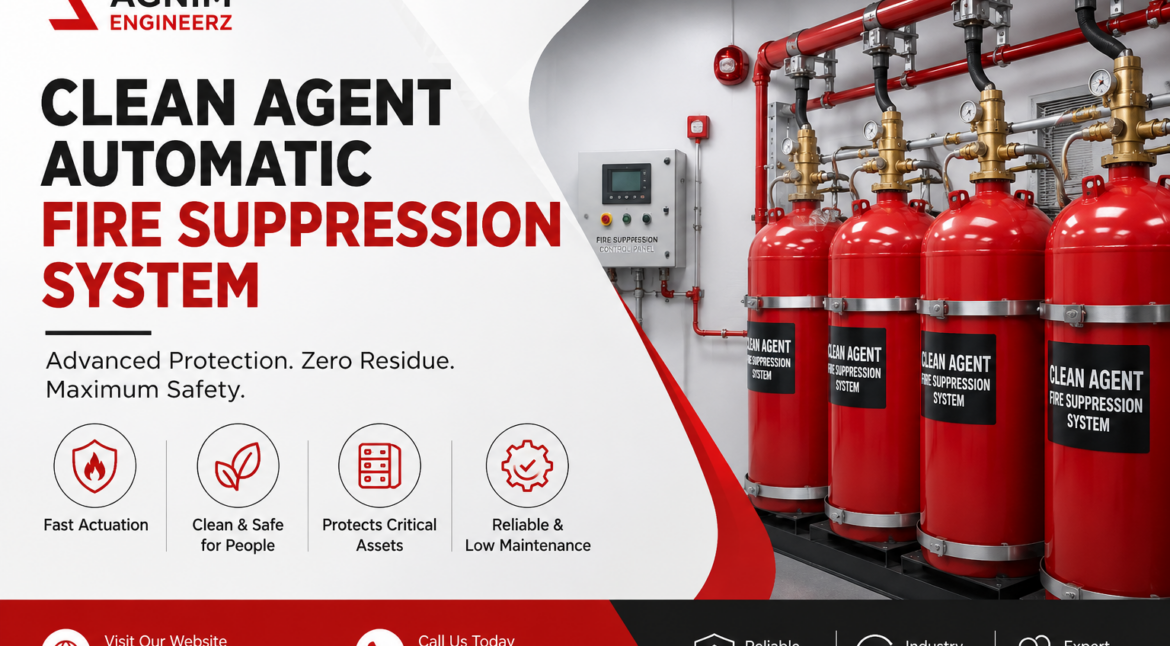
What Is a Clean Agent Automatic Fire Suppression System?
Picture this: a fire starts in your server room at 2 a.m. The sprinklers kick in. The fire goes out, and so does every hard drive, switch, and backup unit in the room. You saved the building but lost the business.
This is exactly the problem a clean agent automatic fire suppression system is built to solve. It puts out the fire without putting out your equipment.
What Is a Clean Agent Fire Suppression System?
A clean agent suppression system is an automatic fire extinguishing system that uses a gaseous agent, either a chemical compound or an inert gas, instead of water or foam to stop a fire.
According to NFPA 2001, the U.S. standard that governs these systems, a clean agent is defined as an electrically non-conducting fire extinguishant that evaporates completely and leaves no residue behind. There’s no water damage, no chemical film, and no cleanup crew needed afterward.
That single feature — zero residue — is why a clean agent fire suppression system has become the default choice anywhere sensitive equipment, documents, or processes can’t survive a soaking.
Why "Clean" Actually Matters
Traditional sprinkler systems are excellent at protecting buildings. They are not so kind to what’s inside them. Water conducts electricity, warps paper, and corrodes metal contacts within minutes of contact.
A clean agent fire system avoids all of that because it works as a gas, not a liquid. It fills the protected space, does its job, and then simply dissipates into the atmosphere or gets vented out. Nothing to wipe down, nothing to replace except what the fire itself damaged.
That’s the whole appeal in one sentence: a clean agent fire suppression system stops the fire while leaving everything else exactly as it was.
How Does a Clean Agent Suppression System Work?
Every clean agent fire suppression system, regardless of brand or agent type, follows roughly the same three-stage sequence.
- Detection. Smoke, heat, or flame detectors sense the earliest signs of fire and send a signal to a dedicated control panel, well before flames spread or smoke becomes visible to the naked eye.
- Discharge. The control panel triggers release valves on a bank of pressurized cylinders. The agent travels through an engineered network of pipes and discharges through nozzles aimed across the protected room.
- Suppression. The agent gets to work through one or more mechanisms — absorbing heat, displacing oxygen, or breaking the chemical chain reaction that keeps a fire burning.
Most systems reach fire-extinguishing concentration in under 10 seconds. For comparison, a conventional sprinkler head can take several minutes to activate and even longer to fully knock down a fire. In a data center, that time difference is the gap between a minor incident report and a total data-loss event.
The Main Types of Clean Agents
Not all clean agents are the same, and picking the right one depends on the space, the budget, and how much cylinder room you actually have.
Halocarbon Agents (Chemical Clean Agents)
These are engineered chemical compounds that suppress fire mainly by absorbing heat.
- FM-200 (HFC-227ea): One of the most widely installed clean agents worldwide. It needs comparatively small storage cylinders, which makes it popular in tight server rooms and electrical panels.
- Novec 1230 (FK-5-1-12): A newer-generation agent with a Global Warming Potential of just 1 and zero ozone depletion potential. It’s the agent of choice for organizations with sustainability targets, since it breaks down in the atmosphere in days rather than years.
Inert Gas Agents
These systems use naturally occurring gases, argon, nitrogen, or blends like IG-541, to lower the oxygen level in a room just enough to stop combustion, while staying safe for people to breathe for the short duration of an evacuation.
Inert gas systems have zero Global Warming Potential and zero Ozone Depletion Potential, which is about as environmentally neutral as fire suppression gets. The trade-off is size: because the gas is stored at high pressure rather than as a liquefied compound, inert gas systems generally need larger cylinder banks than halocarbon systems.
Is a Clean Agent System Safe for People?
Yes—when a clean agent fire extinguishing system is designed correctly under NFPA 2001, it is rated safe for occupied spaces. The concentration levels required to suppress a fire are calculated to stay below the threshold considered hazardous to humans during the typical time it takes to evacuate a room.
That said, “safe for occupied spaces” doesn’t mean people should linger. Standard practice is still to evacuate immediately once an alarm sounds, both as a precaution and because visibility can drop during discharge.
What Fires Can a Clean Agent System Handle?
Clean agent fire suppression systems are effective on:
- Class A fires — ordinary combustibles like paper, wood, and fabric
- Class B fires — flammable liquids and gases
- Class C fires — energized electrical equipment
That range is precisely why they’re so common in mixed-risk environments like server rooms, where you might have paper records, plastic housings, and live electrical circuits all in the same few square meters.
Where Clean Agent Systems Are Used
Some environments simply can’t afford water damage, downtime, or corrosive residue. That’s where clean agent suppression systems earn their keep:
- Data centers and server rooms — protects hardware without frying it in the process
- Electrical panels and UPS rooms — non-conductive, so it’s safe around live equipment
- Pharmaceutical and chemical labs — keeps sensitive processes and clean rooms uncontaminated
- Museums, archives, and libraries — irreplaceable documents and artifacts stay intact
- Telecom exchanges and control rooms — near-zero downtime for infrastructure that can’t go offline
- Oil & gas and industrial control rooms — handles high-hazard zones without halting operations
Clean Agent vs. Traditional Sprinkler Systems
|
Factor |
Clean Agent System |
Water/Foam Sprinkler |
|
Residue after discharge |
None |
Water or foam residue |
|
Safe for electronics |
Yes — non-conductive |
No — risk of short circuits |
|
Cleanup required |
No |
Yes, often extensive |
|
Suppression speed |
Under 10 seconds |
Several minutes |
|
Operational downtime |
Minimal |
Can be significant |
|
Environmental footprint |
Depends on agent (some near-zero GWP) |
Physically damaging, but chemically neutral |
Neither system is universally “better” — sprinklers remain a cost-effective standard for general building protection. But for rooms where the contents are worth more than the walls around them, a clean agent fire suppression system is the more sensible investment.
The Standards Behind Clean Agent Systems
Clean agent fire suppression systems aren’t improvised — they’re engineered to recognized codes:
- NFPA 2001 — the U.S. Standard on Clean Agent Fire Extinguishing Systems, covering agent selection, concentration levels, and human safety limits [1]
- IS 15493 — the Indian Standard for Gaseous Fire Extinguishing Systems
- National Building Code (NBC) of India — fire and life safety provisions for building design
Compliance with these standards isn’t optional paperwork. It determines cylinder sizing, room sealing requirements, detector placement, and how long the agent needs to hold its concentration to actually extinguish the fire — not just knock it down temporarily.
Choosing the Right System for Your Facility
The right clean agent depends on a handful of practical questions: How much floor and ceiling space do you have for cylinders? Does your organization have a GWP target to hit? Is the room occupied during working hours? Is it a retrofit into an existing building or a design for a new one?
These are engineering questions, not guesswork, and they’re best answered with a proper site survey and hazard assessment rather than a generic product catalog.
Frequently Asked Questions
What’s the difference between FM-200 and Novec 1230?
Both are halocarbon clean agents, but Novec 1230 has a far lower Global Warming Potential (1, versus roughly 3,220 for FM-200) and breaks down much faster in the atmosphere [2]. FM-200 typically needs smaller cylinders for the same protected volume.
Do clean agent systems need cleanup after use?
No. The agent evaporates completely, leaving no liquid, powder, or residue. That’s the core reason facilities choose them over sprinklers in the first place.
Are clean agent systems more expensive than sprinklers?
Generally, yes, in upfront cost. But for a server room or archive, the cost of a single water-damage incident often outweighs the price difference many times over.
How often does a clean agent system need maintenance?
These systems require periodic inspection of cylinder pressure, detector function, and control panel integrity, typically as part of an Annual Maintenance Contract (AMC), to stay compliant and ready to fire when needed.
Final Thought
A clean agent automatic fire suppression system isn’t about fighting fire harder — it’s about fighting it smarter, in the specific rooms where water would do almost as much damage as the flames. For data centers, electrical rooms, archives, and any space where downtime and residue aren’t acceptable outcomes, it remains the standard the industry keeps coming back to.
Getting a Clean Agent System Installed the Right Way
Choosing the agent is only half the job — sizing the cylinders, sealing the room, placing detectors, and commissioning the system correctly is what actually determines whether it works when it matters.
Agnim Engineerz, an ISO 9001-certified fire protection EPC company based in Noida, designs, installs, and maintains clean agent fire suppression systems, including FM-200, Novec 1230, and inert gas systems, across Delhi NCR and pan-India for data centers, electrical panels, pharmaceutical facilities, and industrial control rooms. Every installation follows NFPA 2001, IS 15493, and NBC compliance requirements, backed by testing, commissioning, and AMC support.
If you’re evaluating a clean agent fire suppression system for your facility, get in touch with Agnim Engineerz for a site assessment and system recommendation.