

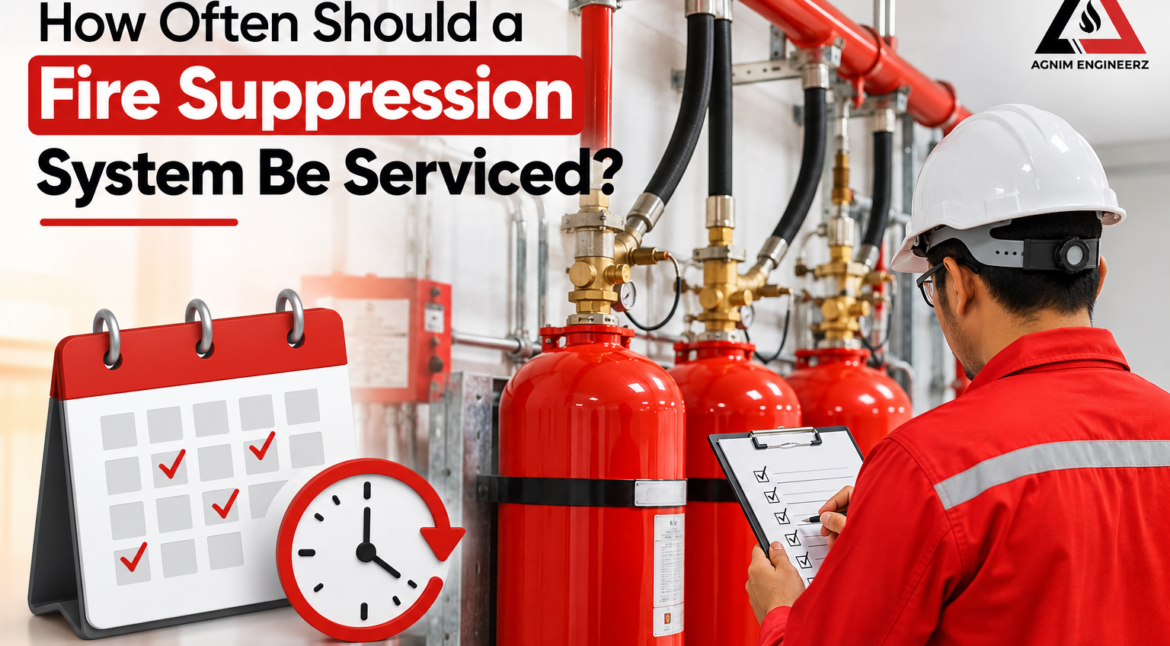
How Often Should a Fire Suppression System Be Serviced?
Short answer: Most fire suppression systems need a professional inspection every six months and a full inspection and test once a year. Staff on site should also check gauges, valves and panel status every month. The exact schedule depends on your system type, the standard behind it, and your local fire authority.
Your system sits quiet for years. Then it gets one chance to work. Regular fire suppression system service is how you make sure it does. A system nobody services is just an expensive wall decoration.
This guide shows the schedule by system type, what each visit covers, and what building owners in Delhi NCR should know in 2026.
Fire Suppression System Service Schedule at a Glance
| Frequency | What happens | Applies to |
|---|---|---|
| Monthly | Control valve and gauge checks; condition check on CO2 systems | Water-based, CO2 |
| Quarterly | Water flow alarm test, main drain test, fire department connection inspection | Water-based |
| Every 6 months | Agent quantity and pressure check, cylinder weighing, full kitchen system service | Clean agent, CO2, wet chemical |
| Annually | Full inspection and functional test | All system types |
| Every 5 to 12 years | Hose tests, cylinder hydrostatic tests, internal pipe inspection | Varies by system and standard edition |
These intervals come from NFPA standards. Confirm them against the edition your fire authority and your equipment manufacturer follow.
Service Frequency by System Type
Water-Based Systems (NFPA 25)
NFPA 25 covers sprinklers, standpipes, fire pumps and water storage tanks. Its schedule has layers. Control valves and gauges get a monthly check. Water flow alarms, main drains and fire department connections get quarterly attention. A full inspection happens every year, and an internal pipe inspection comes around every five years. Electric fire pumps need a weekly inspection and a monthly test run.
Clean Agent Systems (FM-200, Novec 1230, Inert Gas)
NFPA 2001 requires a full inspection and test by competent personnel at least once a year. Technicians also check agent quantity and pressure at least twice a year. They inspect the protected room every 12 months too, because new openings or layout changes can affect how well the agent holds.
The Seattle Fire Department’s inspection checklist, based on NFPA 2001 (2018), expects a halocarbon cylinder to stay under 5% loss of agent quantity and 10% loss of pressure.
Cylinder and hose tests run on multi-year cycles. The interval depends on the cylinder type and the edition of the standard, so follow the manufacturer’s maintenance manual.
CO2 Systems (NFPA 12)
An older NFPA 12 summary calls for a condition check every 30 days and weighing high-pressure cylinders at least twice a year. Transport Canada notes that NFPA 12 requires hydrostatic testing of CO2 cylinders after 12 years of service.
Commercial Kitchen (Wet Chemical) Systems (NFPA 17A)
NFPA 17A calls for a full inspection at least twice a year and after any activation. Technicians replace fusible links and other fixed-temperature elements at least every six months. The cylinders need hydrostatic testing at intervals not exceeding 12 years.
What Fire Suppression System Inspection and Testing Covers
A proper fire suppression system inspection service usually checks:
- Agent quantity and cylinder pressure or weight
- Pipes, nozzles and blow-off caps, for damage, blockage and correct aim
- Detectors, the control panel, manual release and shutoff devices
- Connections to the building fire alarm
- The protected space, for changes since the last visit
- Records, including an updated inspection tag and a written report
A fire suppression system testing service goes one step further and tests release circuits and alarms. Routine six-month tests do not need to discharge the system. The technician disables the release feature first, then runs the checks.
Preventive Maintenance Between Visits
Fire suppression system preventive maintenance fills the gaps between professional visits. Your team can:
- Read gauges and panel indicators monthly, and log the readings
- Keep cylinders, panels and manual pull stations clear of stock and equipment
- Report any fault indication to your service provider promptly
- Tell your provider about renovations, new equipment or a change in room use
A fire suppression system maintenance service then picks up what a monthly walk-through cannot see. Delhi Fire Safety Certificates put the responsibility on management: if a lapse leaves fire equipment non-functional, management answers for it.
Servicing is one layer of a wider plan. See the 7 layers of fire safety for Delhi NCR buildings.
Delhi NCR: Rules Building Owners Should Know
Delhi. The Delhi Fire Service (Amendment) Rules, 2025 changed the process. A Fire Safety Certificate now stays valid unless Delhi Fire Service suspends or cancels it. The owner, occupier or auditor must submit Form K online every year, before the first anniversary of issue. Owners must also hire a Fire Safety Auditor from the Delhi Fire Service portal, and the rules require an automated continuous monitoring system for fire safety measures. Scheduling your annual inspection and testing ahead of the Form K date keeps the paperwork simple.
Rest of NCR. Noida and Ghaziabad (Uttar Pradesh) and Gurugram and Faridabad (Haryana) follow their own state fire rules. Confirm local requirements with your fire office.
National standards. BIS replaced the National Building Code of India 2016 with the National Building Construction Standards 2026 (SP 7:2026). It works as a guidance framework, and states adopt it through their own byelaws. Ask your fire authority which version it references before you submit documents.
Signs Your System Needs Service Sooner
Do not wait for the next scheduled visit if you notice:
- Gauge readings outside the normal range
- Fault or trouble indications on the panel
- Corrosion, dents or damage on cylinders and pipes
- Renovation, new partitions or a change in how the room is used
- A recent activation or accidental discharge
- Missing or expired inspection tags
In these cases, book an emergency fire suppression system service call. Do not leave a doubtful system in service.
How to Choose a Fire Suppression System Service Company
Compare any fire suppression system service company or fire suppression system service contractor on these points:
- Experience with your exact system type
- Technicians who work to NFPA standards and manufacturer manuals
- Clear reports and tags you can show a fire officer or an insurer
- A 24/7 emergency line
- Local knowledge of Delhi NCR approvals
Fire suppression system service for commercial buildings works best under one annual maintenance contract. Offices, factories, warehouses and data rooms often run several systems at once. One contract puts every commercial fire suppression system inspection on a single calendar.
Agnim Engineerz is a Noida-based fire safety EPC company, established in 2017 and ISO 9001:2015 certified. Our team works to FM Global, NFPA and NBC standards. We have delivered projects for manufacturers such as Whirlpool of India and Orient Electric in Faridabad, and our AMC team offers 24/7 support.
FAQs
Every six months by a professional, with a full inspection and test once a year. Monthly checks by your own team fill the gaps.
No. Routine six-month tests do not require a discharge. The technician disables the release feature and tests the circuits and alarms instead.
The owner or occupier. Delhi Fire Safety Certificates state that management is responsible if a lapse leaves fire safety measures non-functional.
Have a qualified technician inspect it before it returns to service. NFPA 17A requires a full inspection of kitchen systems after any activation.
Book Fire Suppression System Service in Delhi NCR
Not sure when your last inspection happened? Start there. Call Agnim Engineerz on +91 93115 92629 or email ankur.t@agnimengineerz.com to schedule an inspection.