


Nobody wakes up excited to think about fire safety. Fair enough. But a fire doesn’t send a calendar invite either, and that’s exactly why sprinkler and suppression systems exist — to do the worrying so you don’t have to.
If you manage a factory in Faridabad, a warehouse in Gurgaon, or a data centre in Noida, this guide walks you through how fire sprinkler systems get installed, when clean agent systems make more sense, and what actually keeps these systems compliant and functional in the Delhi NCR region.
How Fire Sprinkler Installation Actually Works
A fire sprinkler system isn’t just pipes and nozzles bolted to a ceiling. It’s an engineered network, and skipping steps here is how buildings end up with systems that look fine on paper but fail when it matters.
Step 1: Fire Load Calculation and Risk Assessment
Every installation starts with understanding what’s at risk. Engineers calculate the fire load of the building the amount of combustible material per square metre and classify the occupancy as light, ordinary, or extra hazard. Godowns storing textiles behave very differently from an assembly line handling metal parts, and the design has to reflect that difference.
Step 2: System Design
Next comes the design phase. This includes hydraulic calculations, pipe sizing, sprinkler head spacing, and water supply analysis. The National Building Code of India, Part 4 (Fire and Life Safety), sets the minimum framework for Indian buildings, while international sprinkler installers also reference NFPA 13, the globally recognised standard for sprinkler system design and installation. Static pressure, residual pressure, and flow rate all get tested before a single pipe goes up.
Step 3: Approvals and Fire NOC
In Delhi NCR, no commercial or industrial project moves forward without a Fire NOC (No Objection Certificate) from the local fire department. Drawings get submitted, reviewed, and approved before installation begins — and this step alone can make or break your project timeline if it’s handled by someone unfamiliar with local authority requirements.
Step 4: Pipe Network and Sprinkler Head Installation
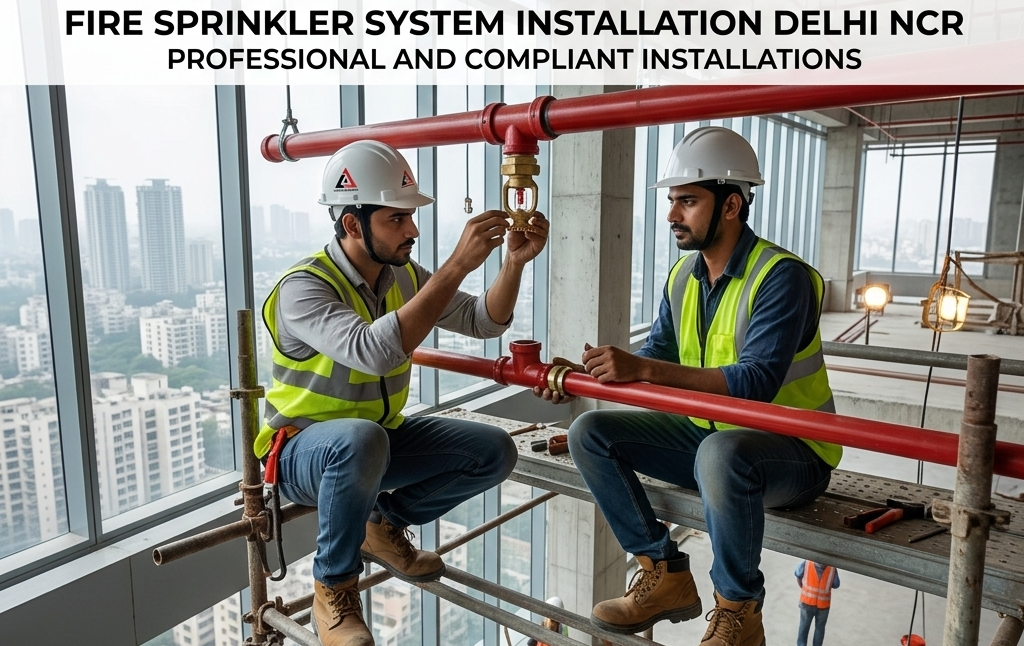
Once approvals are in hand, the actual fitting work starts: hanging and bracing pipework, installing valves, risers, and sprinkler heads, and connecting the network to the pump room. Every component should carry OEM certification, because a sprinkler head that isn’t genuine is a sprinkler head you can’t trust.
Step 5: Pump Room Setup
The pump room is the heart of the system — housing the fire pump, jockey pump, and diesel backup pump that keep water pressure available even during a power cut. Poor pump room maintenance is one of the most common reasons sprinkler systems underperform during real emergencies.
Step 6: Hydrostatic Testing
Before commissioning, the entire system undergoes hydrostatic testing, typically at pressures well above normal operating levels, to confirm there are no leaks or weak joints anywhere in the network.
Step 7: Commissioning and Handover
Finally, the system gets tested in the presence of the fire inspector, certified, and handed over — along with documentation, warranties, and a maintenance schedule.
Done right, this entire process reduces fire-related death risk by a huge margin. Sprinklers, when present and functioning, control or extinguish fires in the vast majority of reported incidents — which is the entire point of going through all seven steps properly instead of cutting corners on step four to save a week.
Fire Sprinkler Contractors in Delhi, Noida, Gurgaon, and Faridabad
Commercial fire sprinkler installation in Delhi and industrial fire protection services in Gurgaon both demand the same discipline: certified materials, trained supervisors, and engineers who understand FM Global, NFPA, and NBC standards side by side. Fire fighting system contractors working across Faridabad and fire safety services in Ghaziabad face the same local reality — mixed-use buildings, tight timelines, and authorities who expect documentation, not shortcuts.
Fire sprinkler contractors in Noida and across the wider NCR belt increasingly work on brownfield projects too — upgrading older systems that no longer meet current norms. This usually means replacing outdated sprinkler heads and piping while reusing components that still perform, rather than ripping out an entire system unnecessarily.
When Water Isn’t the Answer: Clean Agent Fire Suppression
Water puts out fires beautifully. It also destroys servers, rare books, and museum pieces just as effectively. That’s where clean agent fire extinguishing systems step in.
Clean agents are gaseous or vaporising liquid agents that leave no residue after discharge. They extinguish fire by absorbing heat, interfering with the chemical reaction, or displacing oxygen without soaking your equipment in the process.
Where Clean Agent Systems Make Sense
- Data centre fire suppression — protecting server racks where water damage would cost more than the fire itself.
- Server room fire protection — smaller enclosed spaces where fast, clean knockdown matters.
- Museum fire extinguishing systems — protecting irreplaceable artefacts and archives.
- Library fire suppression — safeguarding paper collections and rare manuscripts.
- Electrical room fire protection — keeping switchgear and panels safe without conductive residue.
- Telecom hub fire systems — protecting always-on infrastructure that can’t afford downtime.
NFPA 2001 Compliance
Clean agent systems in India and globally are typically designed around NFPA 2001, the Standard on Clean Agent Fire Extinguishing Systems. This standard governs how these systems are designed, installed, tested, inspected, and maintained so they perform reliably over their entire service life. It covers halocarbon agents like FM-200 and Novec 1230, as well as inert gas agents, each with different cost, storage space, and environmental profiles. Novec 1230, for instance, needs a bit more agent by volume but carries a notably lower global warming potential, which matters if your organisation reports on sustainability metrics.
Design isn’t optional guesswork either — NFPA 2001 requires an egress time study for every clean agent installation, confirming occupants can exit safely within the time the space remains protected.
Clean Agent System Installation Cost
Installation cost depends on room volume, agent type, cylinder bank size, detection and control panel complexity, and piping layout. Inert gas systems generally need more cylinders and floor space, while Novec 1230 and FM-200 systems are more compact — a real consideration in Delhi NCR office buildings where server rooms are rarely generously sized.
Fire Sprinkler Repair, AMC, and Testing in NCR
Installing a system is half the job. Keeping it working is the other half — and it’s the half people forget until an inspection is due.
- Fire sprinkler head replacement — corroded or painted-over heads need swapping, not painting over again.
- Fire pump room maintenance — regular checks on jockey pumps, diesel pumps, and pressure switches.
- Annual maintenance contracts (AMC) — scheduled testing under NFPA 25 principles keeps systems audit-ready year-round.
- System testing and inspection — flow tests, alarm checks, and valve inspections on a fixed calendar.
- Refilling clean agent cylinders — after any discharge, cylinders need proper refilling and re-certification.
- Emergency fire sprinkler repair — for when something needs fixing today, not next week.
An AMC isn’t a sales add-on. It’s the difference between a system that works when tested and a system that works when it actually matters — which, admittedly, is a much worse time to find out it doesn’t.
Frequently Asked Questions
How long does fire sprinkler installation take for a commercial building in Delhi NCR?
Timelines vary with building size and hazard classification, but design, NOC approval, installation, and testing together typically take a few weeks to a few months for mid-sized industrial or commercial sites.
Is a Fire NOC mandatory for warehouses and factories in NCR?
Yes. Commercial, institutional, and industrial buildings across Delhi NCR require Fire NOC approval regardless of height, based on state fire service rules and NBC Part 4 requirements.
What’s the difference between a fire sprinkler system and a clean agent system?
Sprinkler systems use water and suit general commercial and industrial spaces. Clean agent systems use gaseous agents and suit spaces with sensitive equipment, like server rooms, where water damage isn’t acceptable.
How often should a fire sprinkler system be tested?
Regular inspection, testing, and maintenance — following NFPA 25 principles — should happen on a scheduled basis, typically through an AMC, rather than only when a fire department audit is due.
Getting It Right the First Time
Fire safety infrastructure only proves its worth in the one moment nobody wants to test it in real life. That’s exactly why design accuracy, certified materials, and consistent maintenance matter more than the cheapest quote on the table.
Agnim Engineerz, based in Sector 142, Noida, has worked on fire sprinkler, hydrant, and clean agent installations for manufacturing, pharmaceutical, and consumer goods facilities across India since 2017, with project experience spanning Whirlpool, Orient Electric, Bajaj Consumer Care, and Metso Outotec facilities. From fire adequacy studies to pump room installation and ongoing AMC support, the focus stays on one thing: systems that actually work when they’re needed.
If your building is due for a new installation, a system upgrade, or simply a proper AMC that doesn’t just tick a box, it’s worth getting a fire safety expert to look at your site before your insurer or a fire does it for you.