

On Sunday, 13 September 2026, a massive fire broke out at an illegal wood and plywood godown in Dallupura, East Delhi, near Dharamshila Hospital. What started as a single-premises fire escalated fast; four LPG cylinders exploded inside the godown, around 1,500 residents nearby had to be evacuated, and it took more than 30 fire tenders and over 200 firefighters nearly six hours to bring the blaze under control. Smoke was visible as far away as Noida and Sahibabad, and a Delhi Fire Service officer was hospitalised after inhaling smoke during the operation.
No deaths or major injuries were reported this time. But this is the third or fourth godown/warehouse fire of this scale that East and North East Delhi have seen in the past few years, and the pattern behind them barely changes: unauthorised storage, combustible material, and no functioning fire suppression system.
Why the Dallupura Fire Spread So Fast
A few details from the incident explain why it took six hours instead of six minutes to control:
- Combustible storage material. The godown stored wood, plywood, PVC, and thinner chemicals, all of which burn hot and produce thick, toxic smoke that slows down firefighting.
- Unplanned structure. The facility was a tin-shed unit spread across roughly 800 square yards, built in an unauthorised layout typical of many storage units across East Delhi.
- No suppression system on site. There’s no indication the godown had any automatic fire detection or fire suppression system. In a properly protected facility, a fire like this would usually trigger detection and initial suppression within minutes, long before it needs 30 fire tenders.
- LPG cylinders stored alongside flammable stock. Workers reportedly lived and cooked at the site, so LPG cylinders sat inside a space full of combustible material, which is what turned a fire into a series of explosions.
None of this is unique to Dallupura. The same combination shows up across warehouses, godowns, and small manufacturing units throughout Delhi NCR, Noida, Ghaziabad, Faridabad, and Gurugram — which is exactly why fire suppression system design isn’t optional for any facility storing flammable or high-value material.
The Real Cost of Skipping Fire Safety Infrastructure
For a warehouse or industrial unit, an unprotected fire risk isn’t just a safety issue; it’s a business continuity issue:
- Stock and equipment loss that can run into crores within a few hours
- Business interruption while the site is inspected, cleared, and rebuilt
- Regulatory exposure — Delhi Fire Service has been actively acting against unauthorised storage units operating without a valid Fire NOC
- Liability and reputational damage, especially where neighbouring residents are evacuated or injured
For facilities with server rooms or control systems, this risk extends further; an electrical panel fire suppression system protects the equipment that keeps operations running, not just the building itself.
What a Compliant Warehouse or Godown Actually Needs
A facility storing combustible material needs layered protection, not a single extinguisher near the entrance. Here’s what that layering typically looks like, and how the right system is chosen.
Fire detection comes first
Smoke and heat detectors are what buy you the six or seven minutes that separate “put out with a hose reel” from “call in 30 fire tenders”. Detection has to be designed for the specific hazard; a godown storing PVC and thinner needs a different detector spacing and sensitivity than an office floor.
Choosing the right fire suppression sprinkler system
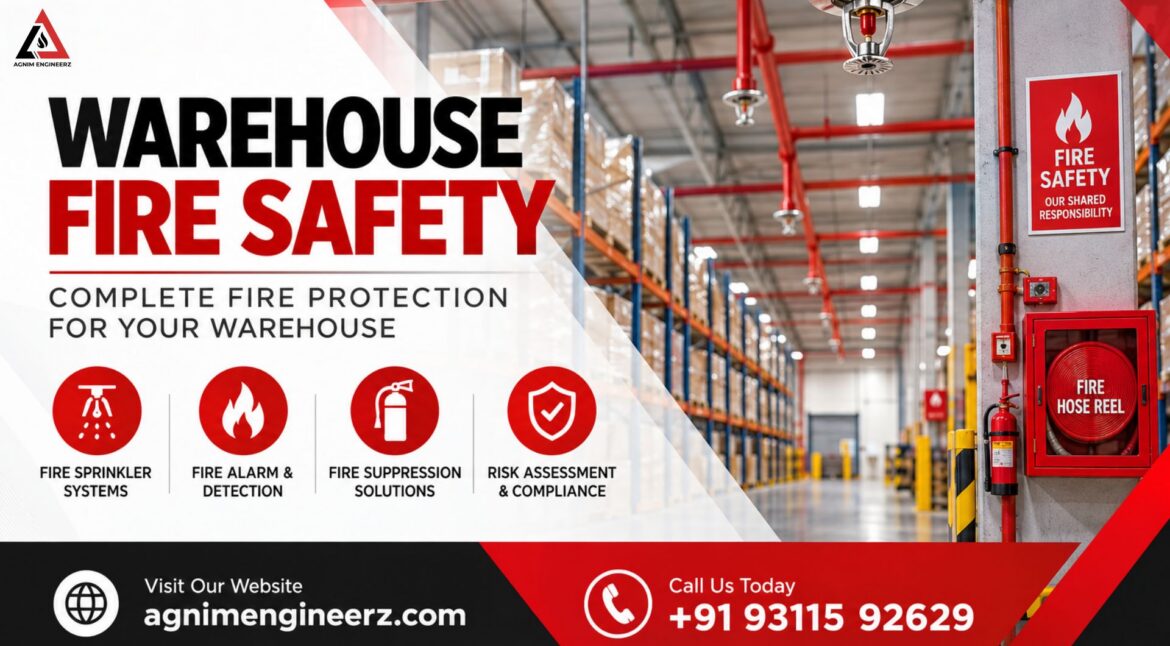
For most warehouses and godowns storing wood, packaging, textiles, or general goods, a fire suppression sprinkler system is the primary line of defence. It’s designed around the fire load of what’s actually stored — a wet-pipe sprinkler network sized for high-hazard occupancy can contain a fire like Dallupura’s within its area of origin, instead of letting it spread across an 800-square-yard shed. Sprinkler design isn’t a fixed template; head spacing, water density, and pump capacity all change based on storage height and material class.
Where a clean agent fire suppression system fits
Sprinklers aren’t right for every space. Server rooms, control panels, and areas with sensitive electronics or documents need a clean agent fire suppression system, which extinguishes fire using a gaseous agent instead of water — protecting the equipment it’s meant to save rather than damaging it further. This is the standard choice for data centres, electrical panel rooms, and any space where water damage would be as costly as the fire itself.
Novec 1230 gas suppression system for high-value, occupied spaces
Within the clean agent category, a Novec 1230 gas suppression system is increasingly the preferred option for occupied spaces and high-value equipment rooms. It’s a non-conductive, low global-warming-potential agent that suppresses fire quickly without leaving residue, and it’s rated safe for use in spaces where people may still be present during discharge — which matters for control rooms and manned facilities that can’t be fully evacuated during working hours.
Hydrant network and pump room
For larger facilities, a hydrant system backed by a correctly sized pump room ensures there’s enough water pressure and reserve capacity to fight a fire that’s already spreading — exactly the scenario Delhi Fire Service faced at Dallupura when 30 tenders had to be deployed in stages.
Fire load calculation and adequacy study
Before any system is designed, the actual fire load calculation for the stored material needs to be done. A godown storing wood and PVC carries a very different fire load than one storing metal parts, and the suppression design has to match it — this is also usually the starting point for Fire NOC approval.
Regular fire safety audits
A one-time installation isn’t enough. Periodic fire safety audits catch degraded equipment, blocked access points, or non-compliant storage practices before they become the next Dallupura.
Frequently Asked Questions
Is a sprinkler system enough, or do I also need a clean agent system? It depends on what’s inside the facility. A fire suppression sprinkler system is usually the right primary system for general storage — wood, packaging, textiles, FMCG goods. But any room with electrical panels, servers, or sensitive equipment needs a clean agent fire suppression system instead, since water damage there would be nearly as costly as fire damage.
What’s the difference between a clean agent system and a Novec 1230 gas suppression system? “Clean agent” is the category; Novec 1230 is a specific agent within it. Compared to older clean agents, a Novec 1230 gas suppression system has a very low environmental impact, is non-conductive, and is rated safe for occupied spaces — which is why it’s commonly specified for control rooms and manned electrical rooms today.
Would a fire suppression system have prevented the Dallupura fire? It’s not possible to say definitively without knowing the exact ignition source, but a functioning detection and suppression system would very likely have contained the fire in its area of origin, rather than letting it grow to the point of requiring 30 fire tenders and a six-hour operation.
How is a fire suppression system designed for a warehouse or godown? It starts with a fire load calculation based on the stored material, followed by a fire adequacy study that determines system type, water/agent quantity, and layout. From there, the system — sprinkler, clean agent, or a hydrant network — is engineered to match that specific risk profile, not a generic template.
Do I need a Fire NOC even for a small godown? Yes. Any storage or industrial premises beyond a certain size, regardless of how informally it operates, is expected to hold a valid Fire NOC. The approval process itself requires meeting baseline standards for exits, hydrant access, and suppression capacity — which is exactly what was missing at the Dallupura site.
How Agnim Engineerz Helps
Agnim Engineerz has been designing and installing fire detection, suppression, and hydrant systems for industrial and warehouse facilities across Delhi NCR since 2017, as an ISO 9001:2015 certified EPC company. Our process typically includes a fire adequacy study and fire load calculation specific to your stored material, design and installation of the right suppression system for your risk profile — sprinkler, clean agent, or Novec 1230 — supported by pump room and hydrant infrastructure, periodic fire safety audits, and ongoing AMC contracts with 24/7 emergency support, so your system stays functional and not just installed once and forgotten.
If your warehouse, godown, or industrial facility in Delhi NCR, Noida, Ghaziabad, Faridabad, or Gurugram doesn’t currently have a certified fire suppression system or hasn’t been audited recently, incidents like the Dallupura fire are a reminder that the cost of prevention is always lower than the cost of recovery.