

What Are the 7 Layers of Fire Safety? A Guide for Delhi NCR Buildings
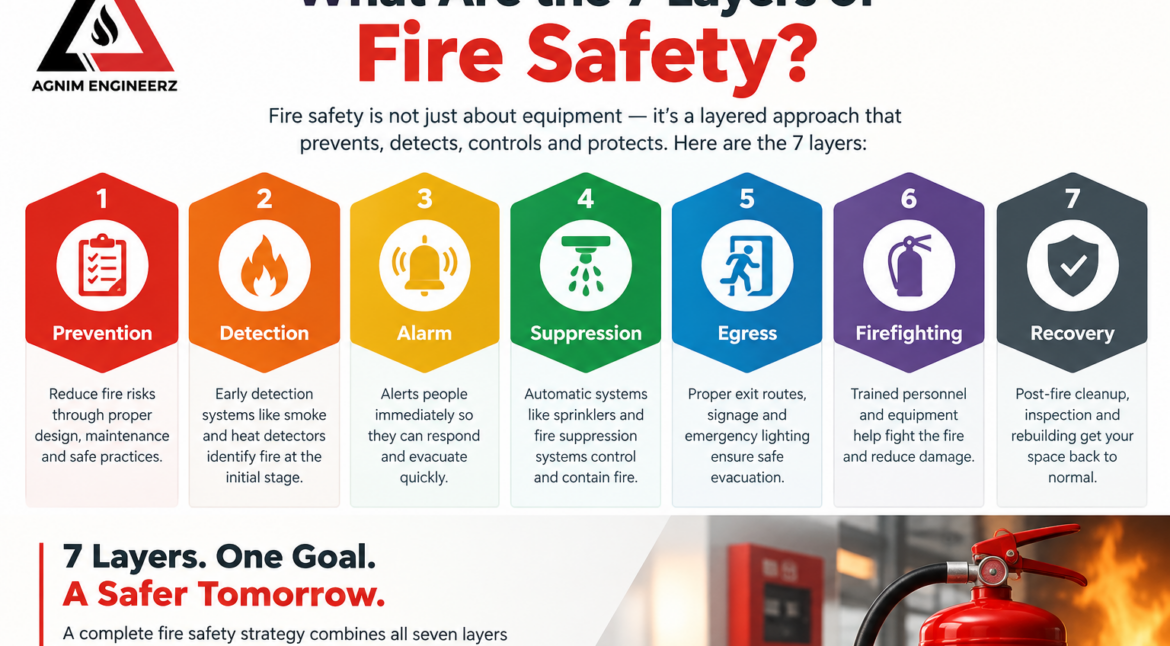
The 7 layers of fire safety are prevention, detection, early suppression, evacuation, compartmentation, structural safety and firefighting. The Modern Building Alliance laid out this framework in its EU Fire Safety Guide. Each layer covers a gap the others leave open, so a building needs all seven working together.
Fire safety is not one gadget on a wall. It is a stack of defences, and when one fails, the next one steps in. This guide explains each layer and the Indian codes that apply to a factory, warehouse, office or hospital in Delhi NCR.
Why one layer is never enough
India recorded 7,054 accidental fire cases in 2023, and 6,891 people died, according to the NCRB’s Accidental Deaths & Suicides in India 2023 report. Residential buildings accounted for 3,738 of those deaths. Commercial buildings added 278 cases and 241 deaths.
A fire does not care that the sprinkler upgrade was “on the list for next quarter.” Any single measure can fail, so engineers stack them.
Layer 1: Prevention
The first layer stops ignition. The EU guide names smoking, electrical faults, cooking and careless handling of ignition sources as the main causes of accidental fires in Europe. Overloaded circuits and unchecked hot work cause the same trouble in Indian facilities. Prevention looks boring, and that is the point:
- Inspect electrical panels and wiring on a schedule.
- Run a hot work permit system for welding and cutting.
- Limit combustible storage and keep housekeeping tight.
A fire load calculation shows how much combustible material your space holds, which tells you how much protection the rest of the stack must provide.
Layer 2: Detection
When a fire starts anyway, early warning buys time. The EU guide points out that smoke will not wake you at night; only a working alarm will. In larger buildings, alarms should link so everyone hears the warning.
In India, IS 2189 covers the selection, installation and maintenance of automatic fire detection and alarm systems. NBC 2016 Part 4 (Fire and Life Safety) sets where a building needs them. Match the detector to the space, because dust, steam and cooking heat each call for different devices. A reliable fire protection system starts with detection that fires at the right moment, not too late and not at every samosa fryer.
Layer 3: Early suppression
Suppression stops a small fire from becoming a big one. According to the EU guide, a manual extinguisher or automatic sprinklers can stop a fire within the first minutes. A fire sprinkler system reacts to heat and discharges water only where the fire is.
NFPA’s study of US fires found that sprinklers operated in 91% of fires large enough to activate them. When they operated, they worked 96% of the time, a combined success rate of 87% (Hall, NFPA, 2011). Those numbers come from US data, but the physics is the same in Noida.
In India, IS 15105:2021 sets the code of practice for designing, installing and maintaining fixed automatic sprinkler systems. Good fire sprinkler installation depends on hydraulic design, a sound pump and tank arrangement, and correct piping. That is why fire sprinkler system installation works best under one EPC contractor who handles design, supply and commissioning. See our fire sprinkler system installation service for the full scope.
Water is not always the answer. Server rooms, electrical panels and paint booths need a different approach, and fire suppression system installation using clean agent or water mist fills that gap. Read more on fire suppression system installation.
Layer 4: Evacuation
If the fire wins the first round, people come first. The EU guide stresses escape routes that are well lit, short and free of smoke, and it flags blocked or cluttered routes as a major problem.
Wire Consultancy’s industrial guide puts it simply: life safety comes before asset protection. Walk your own exits every quarter. If a pallet sits in front of a fire door, move it.
Layer 5: Compartmentation
Compartmentation traps a fire and its smoke in the room where it began. Fire-rated walls and floors, fire doors and sealed joints do the work. They also protect corridors and stairs, which are your escape routes.
Building services quietly undermine this layer. Pipes, ducts and cables pass through fire-rated walls, and unsealed gaps let smoke through. Whenever a contractor drills a new opening, someone must seal it with fire-stopping material.
Layer 6: Structural safety
In a large fire, the building must not collapse on occupants or firefighters. The EU guide notes that engineers test structural elements with the standard fire resistance (furnace) test. In industrial settings, steel columns often get intumescent paint, which swells under heat and slows the temperature rise.
For existing buildings, a structural stability certification confirms the structure can carry its loads.
Layer 7: Firefighting
The last layer is the response: fire services arriving quickly and having what they need once they arrive. Inside your building, that means hydrant systems, a fire pump room, fire water tanks and fire service inlets. Outside, it means roads and access points wide enough for fire tenders. Delhi Fire Service lists access to the building and fire service inlets among the items it checks.
Keep the pump room tested. It is the heart of your water-based system, and nobody remembers it until the day it matters.
The missing eighth layer: people and maintenance
The classic seven do not say who keeps everything working. A fire inspector at Fire Code Solutions argues that training and drills deserve a place in the list. We agree. The US Project FAIL-SAFE research found that compartmentation of smoke and multiple escape routes had the largest effect on occupant survival, and both depend on staff who understand them.
Maintenance matters just as much. An insurer’s summary of NFPA’s 2010–2014 study lists a closed water supply valve as the cause in 59% of sprinkler system failures. Someone closed a valve and forgot to reopen it. A written AMC with checklists prevents that kind of failure. A fire safety audit finds gaps before a real fire does.
What Delhi NCR building owners must check
In Delhi, fire safety falls under the Delhi Fire Service Act, 2007 and the Delhi Fire Service Rules, 2010. Under Rule 27, residential and business buildings taller than 15 metres, or with ground plus four upper storeys, need Delhi Fire Service clearance. The Supreme Court has held that buildings with stilts can reach 17.5 metres under that threshold.
The process runs in two stages. First, you get plan approval and fire safety recommendations before construction. After completion, officers inspect the building and issue a Fire Safety Certificate.
Delhi Fire Service states that responsibility rests with the owner or occupier, and that it does not authorise any vendor to sell or install fire and life safety systems. So pick your contractor on track record, not on claims of “department approval.” Noida, Gurugram, Ghaziabad and Faridabad fall under Uttar Pradesh and Haryana rules, so confirm requirements with the local fire authority.
Quick checklist: all 7 layers
| Layer | Ask yourself | Typical support |
|---|---|---|
| Prevention | Are ignition sources controlled? | Electrical checks, hot work permits |
| Detection | Will we know within minutes? | Detectors, alarm panel (IS 2189) |
| Early suppression | Can we stop a small fire? | Sprinklers (IS 15105), suppression systems |
| Evacuation | Can everyone get out? | Clear routes, signage, drills |
| Compartmentation | Will the fire stay put? | Fire doors, fire-stopping |
| Structural safety | Will the building hold? | Fire resistance, stability certificate |
| Firefighting | Can responders do their job? | Hydrants, pump room, access |
Frequently asked questions
Build the full stack with Agnim Engineerz
Agnim Engineerz provides fire protection services across Delhi NCR as an ISO 9001:2015 certified EPC company based in Noida, operating since 2017. We design, install and maintain sprinkler, hydrant, detection and suppression systems. Our clients include Whirlpool, Orient Electric, Bajaj Consumer Care and Metso Outotec.
Need a fire system installation that covers every layer? Call +91 93115 92629 or contact our team for a site assessment.